Active Warrants can appear suddenly, leaving individuals unsure of their legal standing. A quick active warrant search reveals whether a bench warrant, misdemeanor or felony notice is pending, and the warrant status can be confirmed through the Bernalillo County warrant database. By entering a name or case number, users get instant warrant lookup results that show outstanding warrant records and any recent updates. This fast, online check helps people decide if they need legal representation or a court surrender procedure.
Active Warrants often cause confusion during background checks or employment screenings, making a reliable warrant information lookup essential. The official Bernalillo County portal offers a warrant record search public tool where you can verify active warrants, see if a warrant has been sealed, and understand how system processing delays affect recent entries. If a record seems incorrect, contacting court clerks to resolve misidentifications prevents future complications and ensures your warrant lookup by name is accurate.
How to Search Active Warrants
An active warrant search can show whether Bernalillo County court records list an arrest order that remains in force. Start with the county’s official website, then use any public-record or court-search page linked there for the jurisdiction named on the order. Cross-referencing verified bench warrants helps ensure that public filings and status updates remain accurate. Compare each match with the case number, warrant number, full legal name, and court before acting on the result. This county lookup does not replace advice from a criminal defense lawyer or the clerk of the court named in the record.
Official Search Portal: https://www.bernco.gov/
Steps to Search
- Open the official Bernalillo County website (bernco.gov) and confirm the court named on the warrant.
- Find the current warrant or court-record search through official county links.
- Check the search instructions and required identifiers, such as a name or case number.
- Enter the person’s full legal name, including a middle name or suffix when required.
- For a case-number search, enter the exact number and select the correct court.
- If a warrant-number field is available, enter the exact warrant number.
- Review the results for the name, court, case number, issue date, and status.
- Contact the relevant court clerk to confirm current warrant status. A missing result does not necessarily mean no warrant exists.
What Each Search Term Refers To
Search labels can point to different parts of a court case. A case number usually follows the full case, while a warrant number points to a particular arrest order. Some New Mexico court pages use the term “cause number” for the case identifier, so the document wording should control the search.
Keep copies of the search page, result, and any identifiers used. Screenshots can help a clerk understand what was checked, but a screenshot does not confirm that a warrant remains active. The court record or a current status statement from the issuing court carries greater weight.
Classifications of Active Warrants
An arrest warrant is a court order that permits officers to take a named person into custody. For New Mexico matters, the Arrest Warrant Procedure Act in NMSA 1978, Chapter 14, Article 14 supplies the legal framework. The charge, court order, and current case status matter more than a label used by a third-party search page.
Some result pages combine all three categories in one list. A public record may identify the case type without showing every fact needed to interpret the order. The issuing court can confirm the legal basis for the warrant and any order that changed its status.
Bench Warrants and Failure-to-Appear Notices
A bench warrant is linked to a person’s required presence before the court. It may follow a missed hearing or a failure to meet an appearance condition. A failure-to-appear notice is not proof that a warrant has already been entered, so the court docket or clerk should confirm the actual record.
People sometimes believe that answering a missed-court notice by telephone resolves the issue. A call may start the process, yet it does not prove that the bench warrant was recalled or closed. Anyone listed on such a notice should obtain the current court requirements and confirm that every required appearance has been completed.
Misdemeanor and Felony Warrant Classifications
The misdemeanor or felony label describes the offense connected to the arrest order, not the person’s guilt. A warrant may be issued before the case has been decided. A search result cannot replace the charge, court file, or final court disposition.
The warrant number itself may not reveal whether the underlying allegation is a misdemeanor or felony. Read the court’s current case description or ask the clerk which charge is listed. Posting bond, paying a fee, or calling the court does not by itself prove that an arrest warrant was recalled.
Steps to Take Regarding an Active Warrant
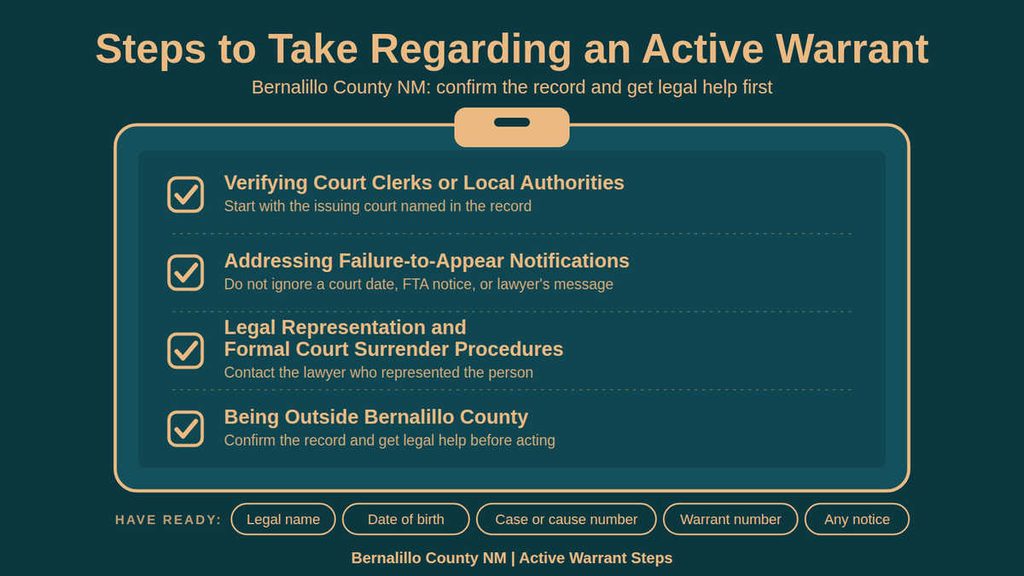
A listed warrant can lead to arrest, so the next step is to confirm the record and obtain legal help rather than testing whether the search page still shows the entry. Do not ignore a court date, FTA notice, or message from a lawyer. A missed deadline can create another legal problem even if the original allegation remains disputed.
Start with the issuing court named in the record. If the source is unclear, contact the criminal defense lawyer who represented the person or the clerk of the court handling the case. Have the legal name, date of birth, cause or case number, warrant number, and any notice ready before calling.
Verifying Court Clerks or Local Authorities
The clerk of the issuing court can explain procedural entries and confirm what the court record currently shows. Ask whether the order remains active, has been recalled, quashed, satisfied, or served, and whether another hearing is scheduled. For wanted persons inquiries, contact the appropriate law enforcement agency to verify current information. Private search pages may not include sealed records or recent updates. Give the clerk the same identifiers that appeared in the result. If the warrant names a police agency for service, the clerk can confirm that detail, yet the clerk cannot give legal advice or decide whether evidence supports dismissal. A criminal defense lawyer should review the charges, court history, and available defenses.
- Confirm the full legal name and every alias previously used with the court.
- Read back the cause or case number and warrant number one digit at a time.
- Ask which court entered the order and which judge or clerk handles the file.
- Request the issue date, last recorded status, and date of any recall, quash, or service.
- Ask for the next hearing date and the name of the court department listed for service.
- Request a copy of the warrant or recall order when the court permits access to it.
If the clerk cannot answer because the search used the wrong court, ask for the correct court name rather than placing calls to unrelated agencies. A record may have moved after a case transfer, appeal, or merger. The original court can often trace where the file went.
Addressing Failure-to-Appear Notifications
Treat each failure-to-appear notice as a separate deadline. Read the hearing date, court, courtroom, contact number, and stated consequence. Missing one appearance can affect bond or release conditions and may lead to a bench warrant if the court finds sufficient grounds to enter one.
A voicemail left with the court may not stop an FTA clock, and a payment may not restore a missed appearance. If the deadline has passed, state that fact plainly when contacting the court. A lawyer can then advise on any required filing, appearance, or bond action based on the case.
Legal Representation and Formal Court Surrender Procedures
A criminal defense lawyer can review the warrant, identify defects in the record, contact the court, and advise on the safest way to respond. The lawyer cannot promise that an arrest will be avoided or that the case will be dismissed. Those results depend on the court, the evidence, and the legal issues in the case.
Surrender normally means appearing as required by the court and the agency listed on the warrant. Some people appear with counsel, while others follow a process set by the court or attorney. The person should not assume that traveling to any police facility will satisfy the order, since the issuing court may require a specific appearance process.
Being Outside Bernalillo County
An active warrant does not normally become invalid because the named person is in another city or state. Local police officers may be able to arrest someone found elsewhere and coordinate with the issuing agency. The exact procedure depends on the agencies, the type of warrant, and the person’s location.
Extradition is a separate legal process and does not begin merely because an online search lists a warrant. A person planning to leave New Mexico should ask a criminal defense lawyer or the issuing court how the warrant could affect travel. Do not assume that an address outside the county makes the order unenforceable.
Record Accuracy and Resolution
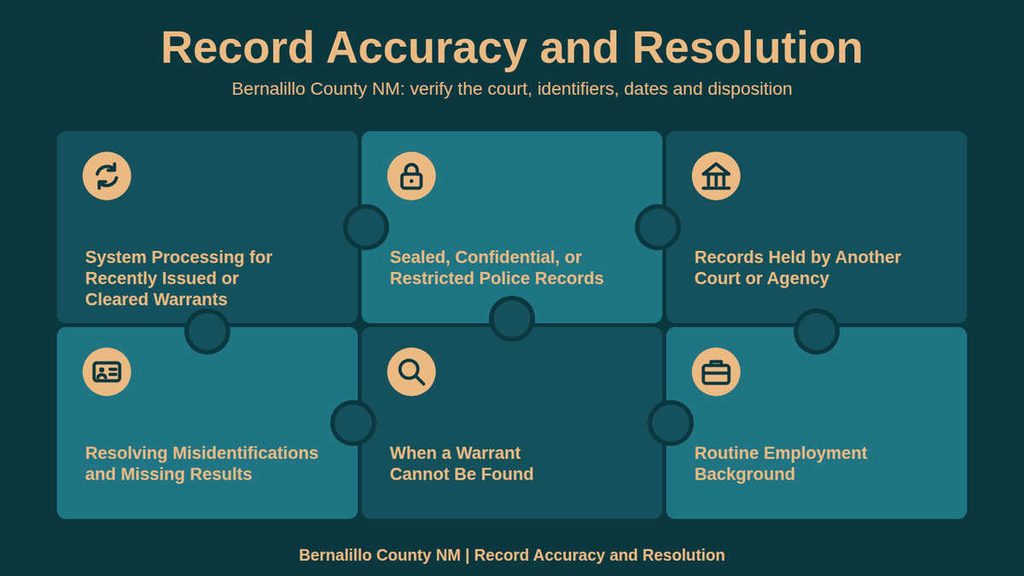
Court records change through several handoffs, so a public screen can differ from the court file for a time. Individuals can also review wanted persons alongside official county files for complete documentation. A person should look for the source of any discrepancy instead of assuming the first or last search result is correct. The safest path is to verify the court, identifiers, dates, and legal disposition through official case channels.
System Processing for Recently Issued or Cleared Warrants
A recalled or quashed warrant may remain on a search page until the court order travels through every connected system. A newly signed warrant may be absent for the same reason. No fixed public update interval should be assumed, since each court and data provider can process entries on a different schedule.
Ask the clerk for the date and wording of any order that recalled, quashed, satisfied, or closed the warrant. This creates a court-based way to compare the legal event with the public search result. A recent appearance alone does not prove that the entry has been updated, so written confirmation is valuable.
Sealed, Confidential, or Restricted Police Records
A sealed, confidential, or restricted matter may not appear in a public warrant search. Juvenile cases and matters sealed by court order can have different public rules. Police investigative records may also stay separate from the court file, so their contents do not always match what the portal displays.
Sealed does not mean active, recalled, or dismissed. The court controls that legal status, and the clerk may be limited in what can be said about a restricted case. If a person believes a relevant matter exists but the search shows nothing, ask the issuing court what public record can be confirmed.
Records Held by Another Court or Agency
An empty result in Bernalillo County may mean the case belongs to another New Mexico county, a municipal court, a federal court located in New Mexico, or another state. Each court system has its own case-number format and public search coverage. A state warrant may also be connected to a case in a different county than the person’s current address.
Use the court name printed on a citation, bond paper, charging document, or notice. If the documents contain no court name, contact the police agency listed on the notice and ask which court holds the case. Do not enter the same case number into unrelated county portals without confirming jurisdiction first.
Resolving Misidentifications and Missing Results
A false match can occur when several people share a name, use the same surname, or once appeared under a different legal name. A birth date shown in a public search page can also be wrong or stored in another format. Confirm several fields before treating a result as the person’s record.
A court clerk may be able to read the correct court entry but lack authority to change it. Some corrections must come from the agency that supplied the data or from the judge through a formal request. A criminal defense lawyer can prepare that request when a warrant affects liberty or an arrest may occur.
If the name is wrong on the warrant, do not wait for an arrest to ask about correction. Bring identification and supporting records to the lawyer or clerk, then request written confirmation of the correction. A police agency can correct its own service data, yet only the court can change the underlying judicial order.
When a Warrant Cannot Be Found
A missing search result can reflect an incorrect name, the wrong court, a recent entry, a closed case, or a record hidden from public view. Avoid repeated searches with random spelling variations, since each attempt may produce a different set of names. Start from the court and case identifiers on the legal documents instead.
If the official court cannot confirm a warrant after checking its records, ask for the search terms and case coverage used by the clerk. A criminal defense lawyer can then check whether another court holds a related case or whether a sealed or transferred record explains the gap.
Routine Employment Background Checks
Routine employment background checks are not the same as an official active warrant search. Each screening product uses a chosen mix of county, state, court, and private sources. Some may omit active warrants, while others can retain an old entry under a former name or case number.
A person who sees warrant details in an employment report should compare them with the issuing court. A missing entry in that report does not prove that no warrant exists, just as an inaccurate entry does not prove one does exist. Use the court’s identifiers and status rather than relying on the employer’s summary alone.
Contact Details
Use the main county number to locate the proper court resource. It is a general county contact rather than a promise of immediate warrant-status confirmation. A court clerk listed on the search result or case documents is the best source for case-specific status.
415 Silver Ave. SW
Albuquerque, NM 87102
Frequently Asked Questions
Active warrants in Bernalillo County affect daily life. Knowing whether a warrant exists helps you avoid surprise arrests, plan legal steps, and keep records straight. The county website offers free lookup tools, and many public‑record sites mirror the same data. Quick checks save time and reduce stress.
How can I perform an active warrant search for a name in Bernalillo County?
Visit the official Bernalillo County site at bernco.gov. Locate the “Public Records” link, then choose “Warrant Search.” Enter the full legal name, case number, or warrant number. Press submit. The system returns any active warrant records, showing case details, court, and status. Verify the spelling matches the court order before trusting the result.
What information does an active warrant lookup by warrant number show?
When you input a warrant number, the database displays the issuing court, the charge, the bond amount, and the date the warrant was issued. It also notes whether the warrant is still active or has been satisfied. This snapshot helps you decide if you need legal counsel or can resolve the matter yourself.
Can I check the status of an outstanding warrant without paying a fee?
Yes. Bernalillo County’s online portal provides free status checks. After entering the required details, the page lists “Active” or “Closed” next to each record. No payment is required unless you request a certified copy, which some agencies charge for.
What steps should I take if an active warrant appears in my search?
First, contact a criminal defense attorney to discuss options. Second, call the county clerk at (505) 468‑7777 to confirm the warrant’s details. Third, arrange surrender at the nearest law enforcement office if advised. Keeping records of all communications protects your rights.
How does a warrant search by case number differ from a name search?
A case‑number search targets a specific docket, reducing unrelated matches. It is useful when you know the exact court file but not the full name. The result lists every warrant tied to that case, including any active orders, dates, and related charges. This method offers precise data for legal review.